

The billion dollar figure mostly works as a signal. It tells LPs the manager is serious and tells everyone the manager is not a seed tourist who flew to Almaty once and came back with a thesis. A lot of the appeal is in that signal and not much else. Strip it off and there is a smaller business underneath, and that smaller business is easy to assemble and hard to run, which is the reverse of how it usually gets pitched.
Some basics for readers who have never thought about Kazakhstan. Twenty million people. An economy somewhere around 290 billion dollars. Internet almost everywhere. The card-payments habit is heavy, heavier than a lot of Western Europe, and there are more e-wallets in circulation than there are citizens. That detail does real work, because the standard frontier-market pitch opens with "step one, get people off cash," and in Kazakhstan that step finished years ago.
One thing about Astana that helps explain everything else. The capital was moved north and largely built from scratch starting in the late 1990s, glass towers dropped onto the steppe by political decision. People have opinions about the architecture. What it shows is the country’s habit with institutions, which is that when it wants one it builds it quickly and assumes the demand will arrive later. The financial centre came out of the same reflex, and we will get to it.
Kaspi
You have probably heard of one Kazakh company and it is Kaspi. Bank first, then a payments network, then a marketplace, and now it is the app most adults open to pay bills, move money, and buy a fridge. It has traded on Nasdaq under KSPI since January 2024 after earlier runs in London and on the local exchanges. A Central Asian fintech on Nasdaq is a real achievement.
The problem is the use people make of it. Kaspi becomes the proof that Kazakhstan can carry a venture portfolio, when what it actually proves is narrower, that the country can produce one very large company. The visiting investor sees one winner and quietly files it as a category, and then a couple of years of deployment go by and the category is still that one company. I have seen this exact mistake in other frontier markets, where a fund nailed its thesis to the local champion and then spent years hunting for the second one. There is a longer essay in why second companies take so long to appear. Not this one. For our purposes the fund would have to treat Kaspi as the high end of what proof looks like rather than the baseline.
- Pre-2024
London & local listings
Earlier public-market runs in London and on the Kazakh exchanges.
- Jan 2024
Nasdaq — KSPI
Kaspi begins trading on Nasdaq; a Central Asian fintech on a US exchange.
Astana Hub and the AIFC
Two institutions come up constantly and the names tell an outsider nothing.
Astana Hub is the state technology park. The reason to care is the tax. Become a participant and you get a long bundle of exemptions, corporate income tax, VAT on some activities, social tax, the result being that a fintech routed through the Hub runs at a tax rate low enough to change the business. It also does the usual incubation and likes to quote its startup count and its regional offshoots. And it admits, more plainly than a government body normally would, that the country is short on investors who will write large later-stage cheques.
The AIFC is the one that matters for forming a fund. Astana International Financial Centre, a zone that runs on English common law principles, with its own court that sits apart from the regular Kazakh judiciary, and its own regulator, AFSA. The court is the part that earns the trust. A London or Gulf lawyer hears "English-law principles, dedicated court" and relaxes, because that is a thing they already understand and do not have to relearn. There are tax advantages stacked on top, including exemption from corporate income tax and VAT on a fund’s investment profit, which matters for the fund vehicle itself and not only the portfolio.
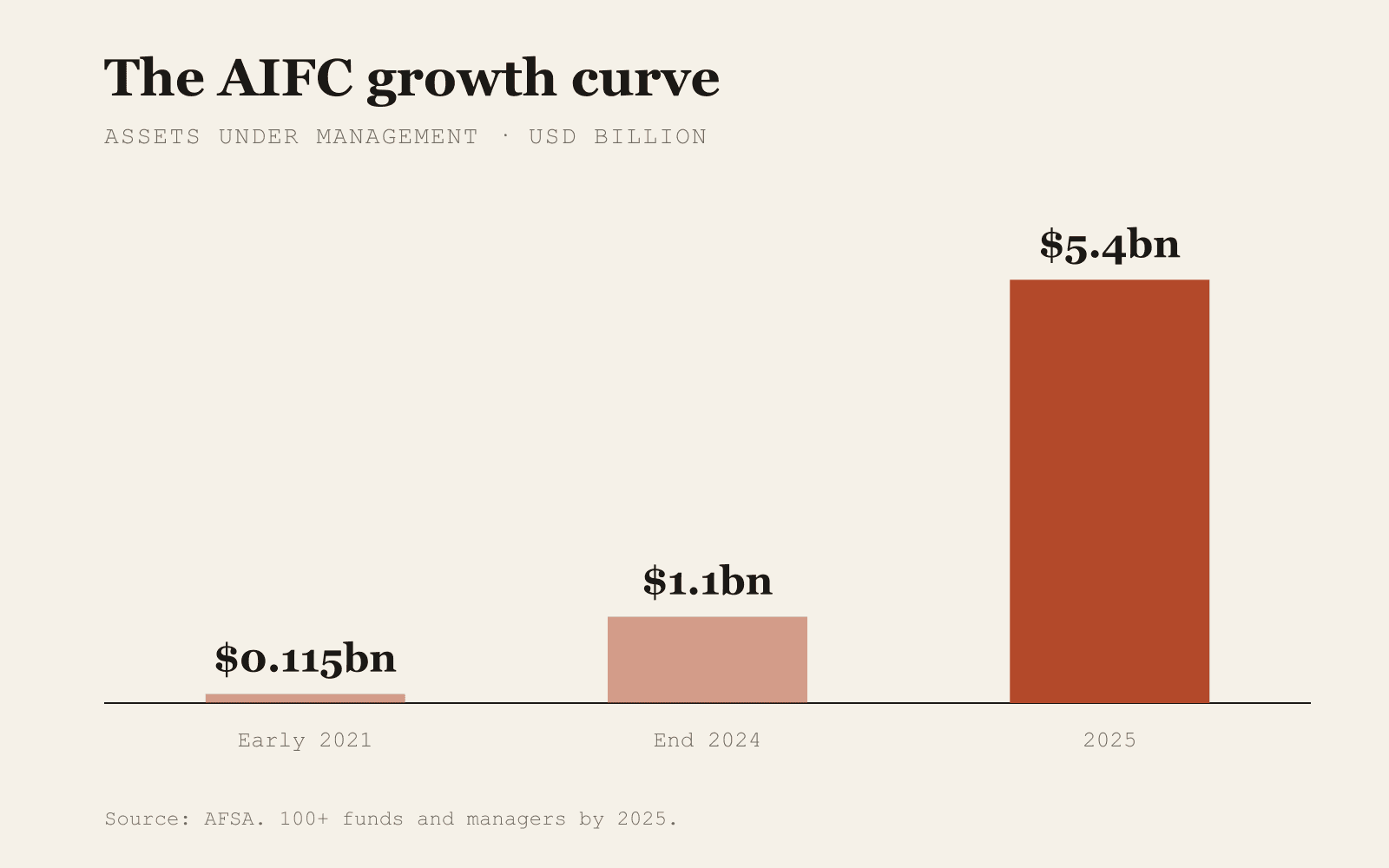
And the numbers are the part that should give a skeptic pause. AIFC asset management grew to more than 5.4 billion dollars by 2025, from roughly 115 million in early 2021, across well over a hundred funds. You can argue about the quality of that AUM and some people do. The slope is not a vanity slope.
The arithmetic
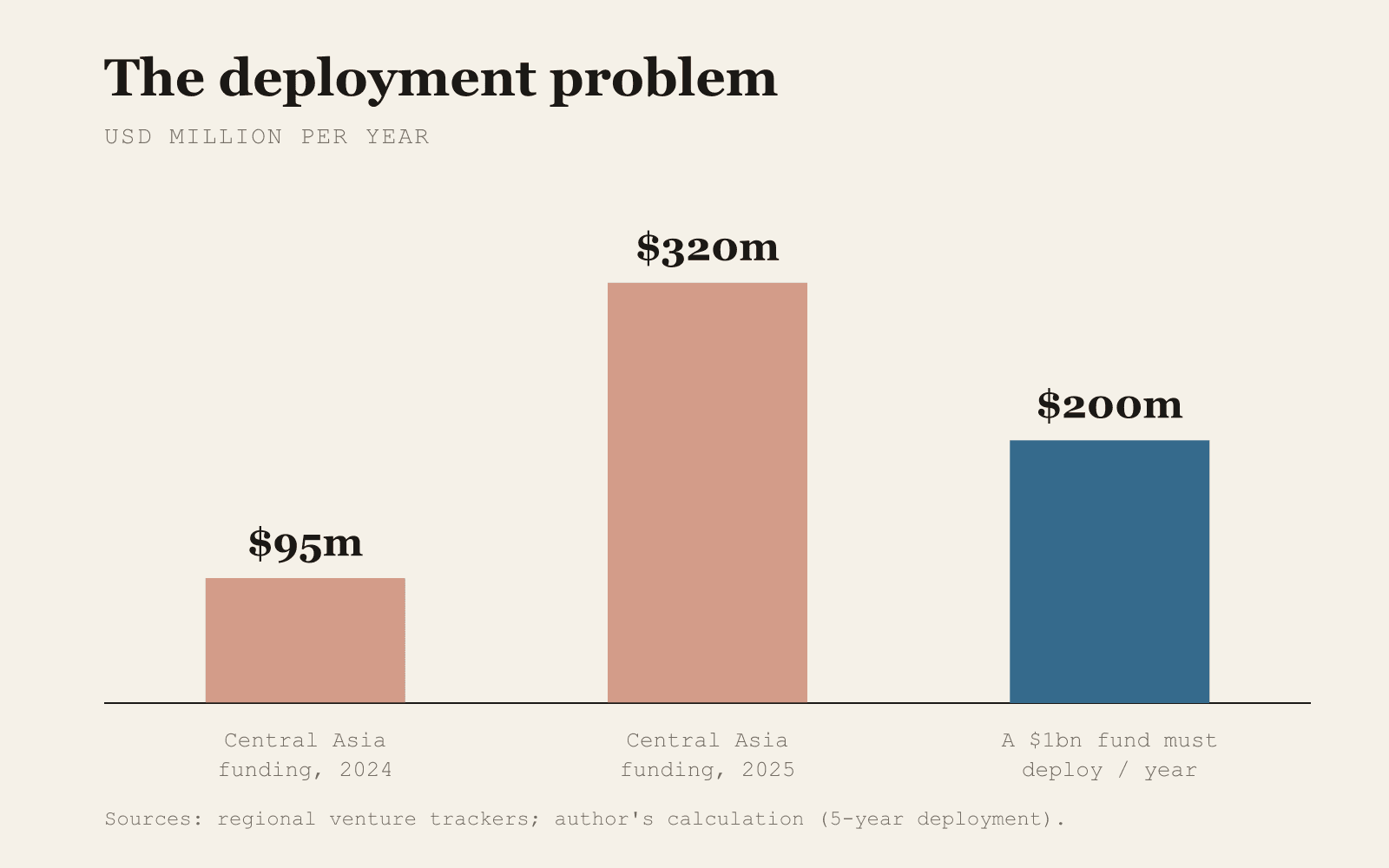
Central Asian venture funding was under a hundred million dollars in 2024 and around 320 million in 2025, and the larger number leaned on a few outsized rounds. Kazakhstan is the biggest piece of that by deal count. So the whole region, in a good year, takes in a few hundred million dollars total.
A billion dollar fund spread over a normal five-year deployment window has to place something like 200 million a year. That is most of the region’s record year, every year, out of one fund. The fund either sits on the money and frustrates its LPs or it drops its standards to get the capital out, and frontier managers usually drop the standards, because parking capital feels like conceding the thesis was wrong.
The realistic shape of this thing is a first close between 150 and 300 million, with a path to more once the markups are real. The Kazakh state is already doing precisely this. Its own venture fund of funds carries a billion dollar headline and opened at a fraction of it, a first close near 115 million from QIC, Freedom Holding, and Astana Hub. So the government, on home turf, is building the billion in stages, which makes the foreign first-timer announcing the full number on day one look underbriefed.
Who would write the cheques
Nobody is sitting on 400 million waiting for a debut Kazakhstan fintech fund. The money is there in layers and the layers have to commit in order.
QIC is the place it starts. Qazaqstan Investment Corporation, a state-linked fund of funds whose whole job is pulling capital into Kazakh-linked funds. It sits across a couple of dozen private equity funds worth several billion dollars combined, and it likes to say it brings in more than two dollars of foreign money for every dollar of its own. Its partner list has included EBRD, IFC, Mubadala, ADQ, CITIC. The list is the evidence. Global institutions will, in fact, sit inside a Kazakh structure when QIC is in the room with them.
Development finance institutions are next and they would be the most credible foreign anchors. EBRD describes itself as the largest fund investor across its regions and commits a few hundred million a year to private-markets funds. IFC backed Sturgeon Capital’s Central Asia fund in 2024 and QIC came into the following one in 2025. These institutions care more about your anti-money-laundering controls than your projected returns, which is a strange sentence if you have only raised from American venture firms, and it is true. They also write tens of millions rather than hundreds, so the fund has to be sized such that a 30 million dollar cheque is a real part of it.
The rest show up later and some never show up. Gulf sovereigns, Kazakh family offices, a few global VCs as co-investors, Western private wealth through offshore feeders. The Western endowments are last and they are last for reasons that have nothing to do with the dinner. They want a structure they recognise, an administrator they trust, audited numbers, sanctions comfort. A first-time Kazakhstan-only manager gives them none of that automatically. A domestic-first raise can work and an SF-first raise mostly produces compliments.
The capital stack, bottom to top
- Domestic quasi-sovereign — the anchor
QIC and state-linked money commit first and give everyone else permission to follow.
- Development finance institutions
The most credible foreign anchors. Tens of millions per cheque, and they care about AML before returns. Precedent: EBRD, IFC, the Sturgeon Capital fund.
- Gulf & Asian strategics
Sovereigns and strategics that already sit beside QIC — Mubadala, ADQ, CITIC.
- Global VCs as co-investors
They co-invest in individual deals long before they commit to the fund itself.
- Western private wealth — last, hardest
Endowments and offshore feeders arrive only once structure, audit and sanctions comfort are all in place.
Where it would be domiciled
The AIFC, almost certainly. The vehicle would most likely be an Exempt Fund offered by private placement to professional clients, with a 50,000 dollar minimum, run through an AFSA-regulated manager. The fees to authorise and supervise are small, a few thousand dollars each. The cost that bites is governance. AFSA wants a senior executive officer, a compliance officer, a money laundering reporting officer, the written policies, all of it, and since the DFI and sovereign LPs were going to demand the same apparatus, it is not a double cost.
A Cayman or Delaware feeder only earns its place once there is genuine Western institutional money on the table, and it changes nothing about the local placement rules when marketing into Kazakhstan.
The thing to avoid, for an international raise, is a purely domestic Kazakh fund. Legal, fine for a small local vehicle, wrong for this. The English-language guidance is thin and you are in the ordinary Kazakh courts rather than the common-law framework that foreign counsel can read without effort, and that gap shows up later as legal fees and lost months. There is more nuance in the national fund law than that summary allows, and a real attempt would need local counsel to confirm the current treatment. I am skating over it because almost nobody building this fund would choose that route anyway.
Author's assessment for an international, institution-backed raise.
How long it would take
Faster than people expect. Entity registration runs about a week on a finished package. The manager authorisation goes through an initial review in roughly a month, a couple of months for the applicant to answer comments, then a decision, and AFSA’s own line is two to three months for a complete application. Budget three to six once hiring approved individuals and building real controls are factored in. Most of a year, intent to wired funds. The timeline is not the hard part of any of this.
- Week 1
Entity registration
About a week on a finished package.
- Month 1
Initial review
AFSA opens its review of the manager application.
- Months 2–3
Remediation
Applicant answers comments; approved individuals hired.
- Month 3–4
Decision
AFSA's own line is two to three months for a complete application.
- Months 3–6
First close
Controls live, funds wired. Most of a year from intent to capital.
The risks that would decide everything
Three serious, two annoying, and the pitch decks spend their time on the annoying two.
Governance perception first. Kazakhstan sits mid-table on the main corruption index, and the OECD keeps a list of institutions that still need work. For a fund this size the generic governance package does not survive diligence. Independent investment committee with credible outsiders, an LP advisory committee with reserved powers that mean something, external administration, audited valuations. Each one is a box a nervous development bank ticks before it believes the rest of what you tell it.
Then sanctions and money laundering, which is the risk nobody talks their way out of, because of the volume of trade between Kazakhstan and Russia. Western governments keep flagging third-country evasion, and they also credit Kazakhstan with commitments to follow partner sanctions regimes, and both are accurate, which is exactly why it is a screening problem rather than a yes-or-no problem. The fund would need source-of-wealth work and Russia-exposure screening at the LP and portfolio level and a sanctions committee with the authority to kill a deal. One bad LP ends it.
The exit market third. The Astana exchange is growing and still small. Most companies here get out by selling to a bank, a payments firm, a telecom, or a bigger foreign fund. Public listings are the Kaspi exception. A fund that wants to sleep at night underwrites as though the IPO will never come.
The two annoying ones. Data localisation forces Kazakh personal data onto servers inside the country, so cloud architecture becomes a diligence conversation instead of a default. And the tenge moves enough that a dollar-denominated fund holding tenge-earning companies has to keep its marks honest. Both are the kind of thing competent operators deal with without much drama.
Three serious risks, two manageable ones.
What would actually happen
The version that works does not look like the billion dollar version that opened this. It is an AIFC fund with an AIFC-regulated manager. The mandate is Kazakhstan-centred but loose enough to follow founders into the rest of Central Asia and the diaspora. It closes 150 to 300 million off QIC-style domestic money and a development bank or two. It runs governance that belongs in a much bigger fund. It buys into the fintech where the adoption already happened, payments rails, merchant and SME finance, bank-tech integration, digital identity, fraud and AML tooling, regtech, and the thin strip of digital-asset infrastructure that fits inside the AIFC and central-bank rules. It avoids balance-sheet lending and the loosely regulated crypto that has killed frontier funds before.
If the billion ever shows up it shows up in pieces and it shows up late. Co-investment vehicles for the large LPs, an opportunity fund for the growth-stage follow-ons, an SPV now and then for a round too big for the main fund, maybe a development-bank sidecar for one priority theme. Five or six years in the whole platform might get near a billion in total AUM. That is a very different thing from a billion on day one, and the difference is the entire point.
"The fund that gets to a billion here, if one ever does, is the one that was patient enough to start small."
Which leaves the question more or less answered, though not as cleanly as a headline would want. The billion can be raised and structured, and the AIFC makes that part unusually easy for the region. The deployment is the constraint, and it will stay the constraint until there are enough fundable companies to absorb the money, which is a thing that happens slowly and mostly out of view. Kazakhstan has the users and the rails and the law and one company on Nasdaq. What it is still building is the supply of companies, and that is the number worth watching, more than any fund’s headline.
The corridor, in your inbox every Sunday.
One documentary-grade read on Central Eurasian founders, funding and fintech regulation.